18 Stylish Grey Two-Tone Deck Ideas for 2026

Is your dream of a beautiful outdoor space being held hostage by the fear of choosing the wrong deck color?
You’re not alone. Most homeowners pick a single color because it feels safe. But a one-tone deck often looks flat. It blends into the background instead of making your home stand out. And picking two colors that work together? That feels risky.
This guide solves that. You’ll get 18 stylish grey two-tone deck ideas that add depth, define spaces, and boost your home’s value. You’ll learn the top 2026 color trends so your deck stays modern for years. Plus, you’ll get DIY tips on staining and choosing the right materials – wood or composite.
Let’s get started.
Decoding the Grey Palette: Foundational Two-Tone Pairs
Before you go bold, start with the basics. These four ideas pair different grey shades with neutral colors. They’re hard to mess up. And they work on almost any house.
Idea #1: Warm Grey + White Trim for Timeless Curb Appeal

Warm greys are having a moment. In 2026, they now make up 35% of deck projects. Cool silvers? They’re dropping in popularity.
Pair a warm grey deck floor with crisp white railings and trim. The result is clean, classic, and welcoming.
- Why it works: White brightens the space. Warm grey grounds it.
- Best for: Farmhouses, cottages, and traditional homes.
- Product example: Trex “Gravel Path” (warm grey) with white aluminum railings.
Action tip: Use white fascias (the vertical board that covers the deck’s edge). It ties the whole look together.
Idea #2: Cool Light Grey + Deep Charcoal for Modern Elegance

Want a sleek, almost urban feel? Go cool.
Light grey boards with deep charcoal railings or borders feel crisp and contemporary. Think loft apartment, but outdoors.
- Why it works: High contrast makes the grey tones pop without being loud.
- Best for: Modern homes, new builds, and minimalist designs.
- Product example: Deckorators Altitude “Trailstone” (cool light grey) with a dark charcoal picture frame.
Practical bonus: Lighter grey stays cooler underfoot in direct summer sun. That’s a real win if your deck faces west.
Idea #3: Light Grey + Soft Greige for Biophilic Design
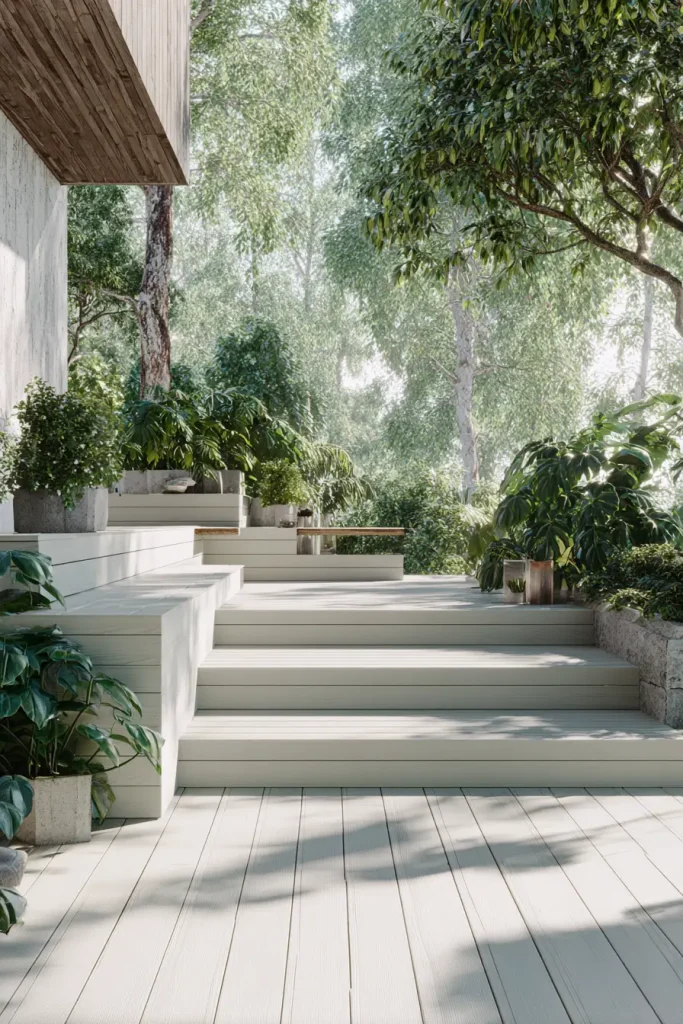
Greige is grey-beige. It’s the neutral that connects your deck to nature.
Combine a light grey deck with greige accents – maybe the stairs or a built-in bench. This palette feels soft, organic, and calm.
- Why it works: It mimics natural stone and weathered wood.
- Best for: Homes surrounded by trees, gardens, or natural landscapes.
- 2026 trend note: Biophilic design (connecting with nature) is growing fast. This palette nails it.
Action tip: Add potted plants with dark green leaves. The contrast makes both colors sing.
Idea #4: Mid-Grey + Anthracite for a Picture Frame Border

A picture frame border means you lay a different color around the deck’s perimeter. The center is one shade. The border is another.
Pick mid-grey for the main field. Use anthracite (very dark grey) for the outer frame.
- Why it works: The dark border acts like a visual anchor. It stops your eye and makes the deck look intentional and expensive.
- Best for: Rectangular decks, raised decks, and any space that needs structure.
- Cost note: This uses about 15% more of the darker boards. But the value jump in appearance is huge.
Action tip: Keep the border width consistent – 12 to 18 inches works best.
High-Contrast and Dramatic Grey Combinations
Ready to step beyond the basics? These four ideas add real drama. They’re for homeowners who want their deck to feel like a statement.
Idea #5: Mist Grey + Black Railings for Bold, Modern Contrast

This is a favorite in 2026. A light mist-grey floor paired with matte black railings and balusters.
The look is crisp, confident, and a little bit edgy.
- Why it works: Black recedes visually. It makes the grey feel lighter and the space feel larger.
- Stat to know: About 10% of new decks now use deep charcoal or black railings for this exact reason.
- Best for: Contemporary homes, urban townhouses, and anyone who likes clean lines.
Action tip: Use cable railings in black for an even more open view.
Idea #6: Weathered Grey + Espresso Brown for Rich, Organic Depth

Grey doesn’t have to be cold. Pair weathered grey boards with espresso brown fascia, stairs, or a raised planter.
The combination feels rich and natural – like driftwood next to dark soil.
- Why it works: Espresso adds warmth. Weathered grey adds texture. Together, they feel grounded.
- 2026 trend: Deep walnut and espresso tones are trending for adding depth to outdoor spaces.
- Best for: Rustic homes, cabins, and modern farmhouses.
Product example: TimberTech’s “Vintage” line in Coastline (weathered grey) with Espresso railings.
Idea #7: Slate Grey + Navy Blue for a Coastal Yet Sophisticated Vibe

Forget bright beachy blues. Navy blue is the grown-up coastal color.
Paint your railings or pergola in deep navy. Keep the deck floor in a cooler slate grey.
- Why it works: Slate grey anchors the navy. The combination feels calm, not kitschy.
- Best for: Coastal homes, lake houses, and anyone who wants a nautical nod without the clichés.
- Pro tip: Add brass or gold light fixtures. The warm metal against cool navy and slate is stunning.
Action tip: Test navy against your home’s siding. It works best with white, beige, or light blue exteriors.
Idea #8: Light Grey Main Deck + Dark Grey Fascia and Skirting

Most people forget the fascia (the deck’s outer edge) and skirting (the cover underneath). That’s a missed opportunity.
Keep your main deck boards light grey. Then paint or install dark grey fascia and solid skirting.
- Why it works: The dark skirting hides dirt and cobwebs. And it makes the light grey floor look like it’s floating.
- Best for: Decks that are raised more than 2 feet off the ground.
- Material note: Composite fascia comes in matching colors. Or use a solid stain on wood fascia.
Action tip: Match your skirting color to your house’s foundation or trim for a seamless look.
Functional Two-Tone Layouts and Patterns
Now we move beyond color. These four ideas use the arrangement of boards to create a two-tone effect. Pattern matters as much as paint.
Idea #9: Picture Frame Border for a Premium Finished Edge

We mentioned this earlier. But it’s worth repeating because it works so well.
Use a darker grey for the border and a lighter grey for the main field.
- Visual benefit: The dark border creates a “rug” effect. It defines the deck as its own room.
- Safety benefit: Frame your stairs in dark grey and use light grey on the steps. The contrast helps people see each step edge – especially at dusk.
- Best for: Any deck that needs a custom, high-end look.
How to get this look: Plan your border width before buying materials. Each corner needs a 45-degree miter cut.
Idea #10: Herringbone or Chevron in Two Grey Tones for Visual Motion

Herringbone (angled V shapes) or chevron (continuous V pattern) turns your deck into art.
Alternate two shades of grey – say, light and mid-grey – in the pattern.
- Why it works: The human eye loves patterns. Herringbone makes a flat deck feel dynamic.
- Difficulty level: High. This is not a beginner DIY. Hire a pro unless you have serious carpentry skills.
- Best for: Large decks where you can see the whole pattern from above (like from a second-story window).
Cost warning: Patterned layouts create up to 30% more waste. Budget for extra boards.
Idea #11: Zoning the Deck with Light and Dark Boards
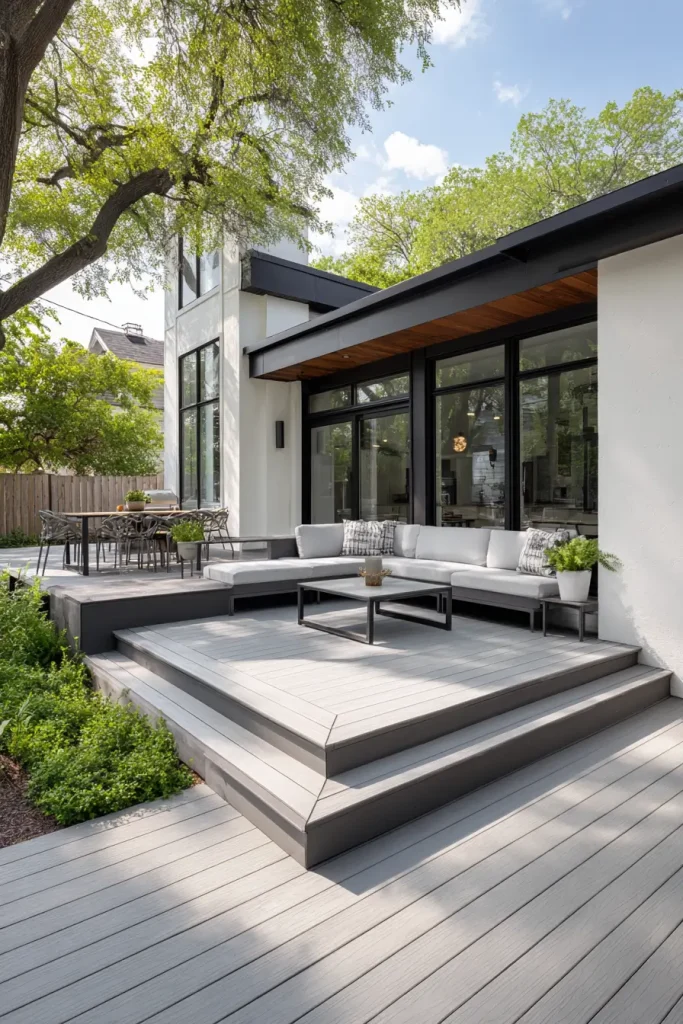
You don’t need walls to separate spaces. You can use color.
Make the dining zone darker grey. Make the lounge zone lighter grey. Or reverse it.
- Why it works: Color zoning tells your brain “this area is for eating” and “this area is for relaxing.” It’s subtle but effective.
- Example: A 16×20 deck. The 8×10 area near the house is light grey (lounge). The outer 8×10 is dark grey (dining with grill).
- Best for: Large decks (over 200 square feet) or L-shaped decks.
Action tip: Use the same board direction across both zones. Keep it consistent. The color change alone is enough to define each area.
Idea #12: Diagonal Decking Pattern to Make a Narrow Space Appear Wider
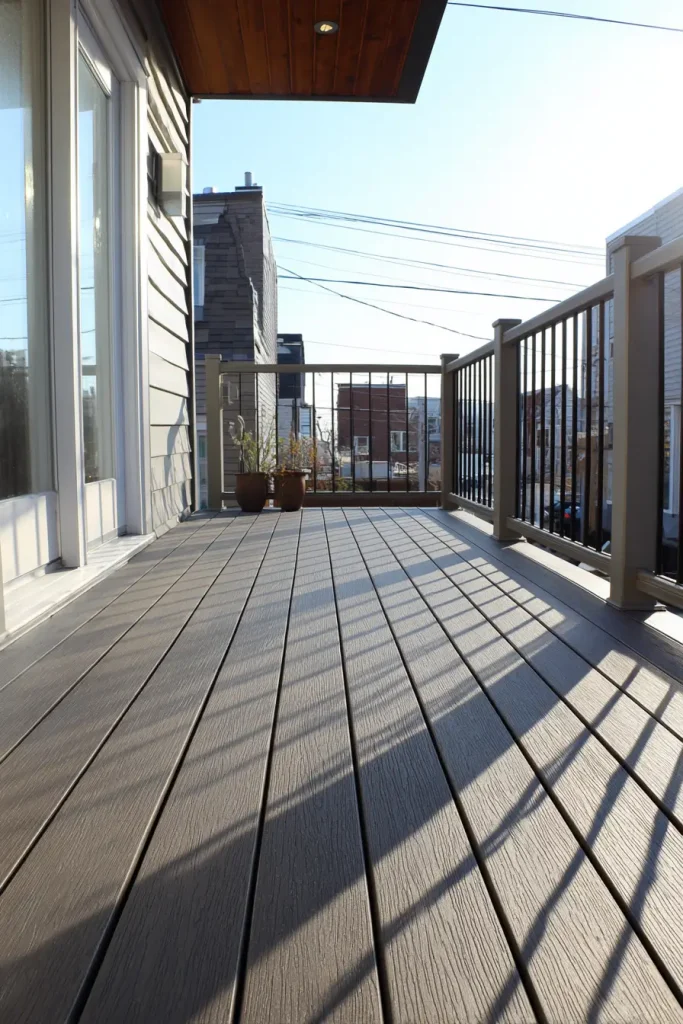
A narrow deck feels like a hallway – tight and awkward.
Lay your deck boards on a 45-degree diagonal instead of straight. Use two grey tones in alternating diagonal rows.
- Why it works: Diagonal lines trick the eye into seeing more width.
- Best for: Townhouse decks, side-yard decks, and any space that’s longer than it is wide.
- Difficulty: Medium. More cuts than straight lay, but less complex than herringbone.
Pro tip: Start your diagonal layout from the center of the deck and work outward. This keeps the pattern balanced.
Staining Your Way to a Stylish Two-Tone Deck
Already have a wood deck? You don’t need to rip it out. Staining gives you a two-tone look for a fraction of the cost.
These four ideas are for DIYers.
Idea #13: Semi-Transparent Floor + Solid Color Railings (The Pro Method)
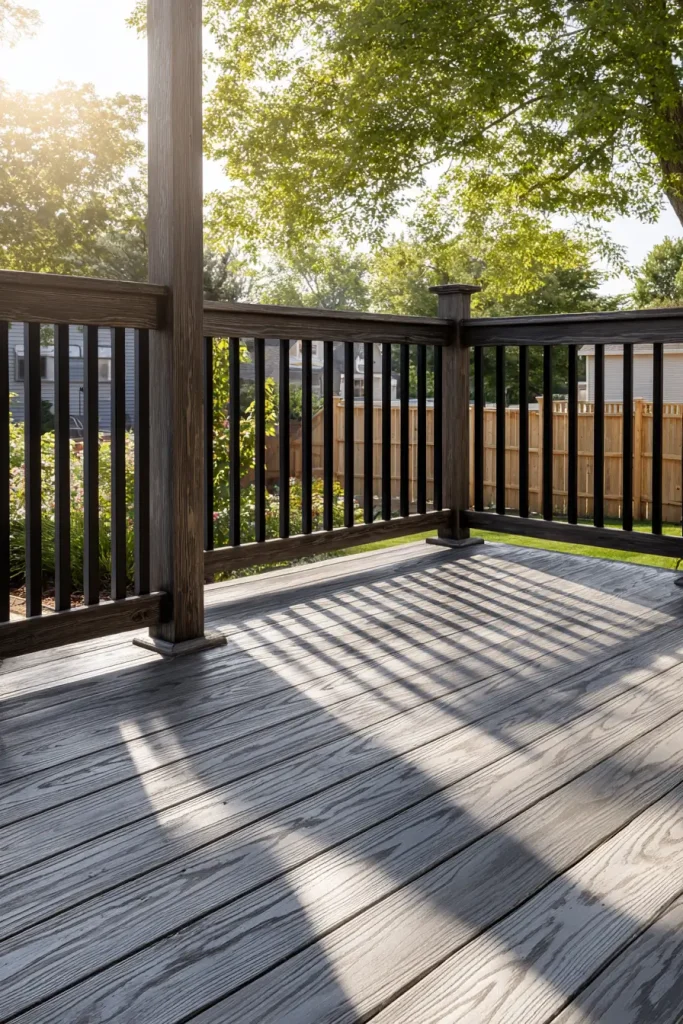
This is the single best piece of advice from deck staining expert Scott Paul (30+ years experience) .
Use a semi-transparent stain on your deck floor. It lasts 2-3 years but lets the wood grain show. Use a solid stain on your railings and spindles. Solid stains last 6 to 10 years on vertical surfaces.
- Color pair: Semi-transparent grey on the floor. Solid charcoal grey on the railings.
- Why it works: Solid stain hides dings and hand oils on railings. Semi-transparent shows off wood grain on the floor where it matters most.
Action tip: Solid stains can be tinted to any color. Semi-transparent stains are limited to browns, reds, and greys.
Idea #14: Ombre Effect – Staining Stairs from Light to Dark Grey

Ombre means gradual fade. Start with light grey on your top step. Get slightly darker on each step down. End with charcoal at ground level.
- Why it works: It draws your eye downward and makes stairs feel intentional, not just functional.
- Difficulty: Medium. You’ll need to mix stain shades or buy multiple colors.
- Best for: Decks with 4 or more steps.
Technical stat (Sherwin-Williams): Don’t stain in direct sunlight. The stain dries too fast and leaves lap marks. Wait for a cloudy day. Leave 4 hours between coats. Allow 24-48 hours dry time before walking on it.
Idea #15: Reverse Two-Tone – Light Frame, Dark Interior
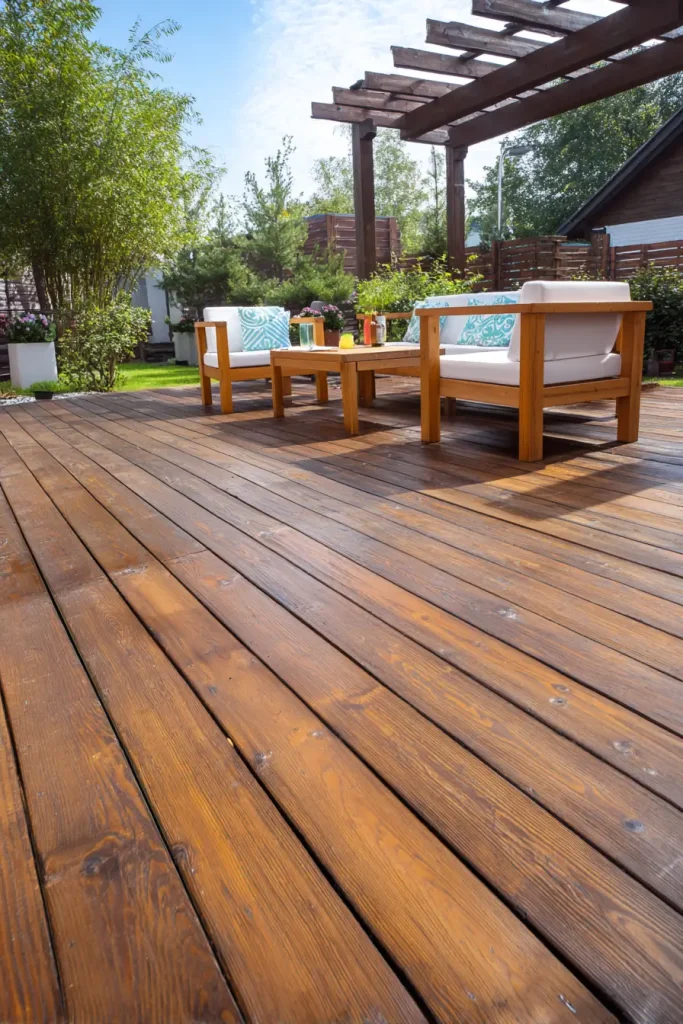
Most two-tone decks put the dark color on the border. Flip that.
Stain your picture frame border light grey. Stain the interior field dark grey.
- Why it works: The dark interior feels like a cozy carpet. The light frame acts like a glowing edge.
- Best for: Bungalows, cottages, and small decks where you want warm intimacy.
- Visual effect: This makes the deck feel smaller but more inviting. Use it for seating areas, not dining zones.
Action tip: Keep your furniture light-colored (white or natural wood) so it doesn’t disappear into the dark field.
Idea #16: Accent Stripes – Boardwalk-Style Runner with Contrasting Stain

Paint or stain a 3-foot-wide stripe down the middle of your deck. Use a lighter or darker grey than the main floor.
This mimics a boardwalk runner.
- Why it works: It creates a visual pathway. Your eyes follow the stripe, which makes the deck feel longer.
- Best for: Long, narrow decks or decks that connect to a garden path.
- DIY difficulty: Low. Just tape off a straight line and roll on the contrasting stain.
Pro tip: Use a solid stain for the stripe so the color stays crisp. Semi-transparent stains bleed under tape.
Materials, Accents, and Finishing Touches for Your Deck
The last two ideas focus on mixing materials and adding accessories. A great two-tone deck isn’t just about boards. It’s about the whole package.
Idea #17: Natural Stone Features + Grey Decking for an Organic Feel

Grey decking pairs beautifully with natural stone. Think flagstone steps leading up to the deck. Or a stone fire pit set into the deck surface. Or a stone veneer on deck support posts.
- Why it works: Stone has natural variation and texture. Grey decking is smooth and uniform. They balance each other.
- 2026 trend: Multi-tonal boards are trending to mimic natural variation found in real hardwoods. Stone takes that even further.
- Best for: Decks in wooded or mountainous areas.
Action tip: Match the warm or cool tone of your grey deck to the stone. Warm grey pairs with sandstone and limestone. Cool grey pairs with slate and bluestone.
Idea #18: Mixing Smooth and Wood-Look Composite Boards in Two Grey Tones

Composite decking isn’t all the same. Some boards are smooth. Others have a wood-grain texture.
Pick two grey tones – one in a smooth finish, one in a textured wood look. Alternate them.
- Why it works: The texture difference adds depth even before you notice the color difference.
- Brands to look at: Trex (Transcend line), TimberTech (Legacy line), Deckorators (Voyage line), Tangent (Performance line).
- Best for: High-end builds where budget isn’t the main concern.
Action tip: Order free sample boxes from Trex, TimberTech, and Deckorators. See the colors and textures in your own backyard before buying.
Pro Tip: Using Outdoor Rugs and Cushions to Introduce a “Third” Accent Color
You don’t have to commit to a third color permanently. Test it first with textiles.
Place outdoor cushions in olive green, terracotta, or mustard yellow on your grey deck. Add a rug with that same accent color.
- Why it works: This shows you how a third color will feel before you paint anything or buy new furniture.
- Best accent colors for grey: Navy blue, olive green, rust orange, warm yellow, and natural wood tones.
Action tip: Leave the cushions and rug out for a week. Look at them in morning light, noon sun, and evening shade. That’s your real test.
Pro Tip: Selecting the Right Deck Lighting to Enhance Your Two-Tone Design
Lighting changes everything. White light makes cool greys look sharper. Warm light (2700K-3000K) makes warm greys look richer.
- Best lighting types for two-tone decks:
- Post cap lights: Define the deck perimeter.
- Step riser lights: Highlight contrast on stairs.
- Under-rail lights: Wash the floor with soft glow.
- What to avoid: Blue-toned LEDs (5000K+). They make greys look cold and uninviting.
Action tip: Buy one low-voltage step light and test it on your deck at night before buying a full system.
Conclusion
A two-tone grey deck is one of the smartest upgrades you can make. It adds depth and style without the headache of painting or high maintenance.
Here’s what to remember:
- Warm greys are the 2026 trend (think Trex Gravel Path, not silver).
- Dark borders add instant structure.
- For existing wood decks, use semi-transparent on floors and solid on railings.
- Test third colors with cushions and rugs before committing.
Which of these 18 stylish grey two-tone deck ideas will you bring to life? For more help, order free composite samples from Trex or TimberTech. And if you need cost estimates, check our related guide on deck building budgets.
Your outdoor space should feel like an extension of your home – not an afterthought. Pick two greys. Make a plan. Build something you’ll love for years.