15 Walk-in Shower Ideas for Small Bathrooms
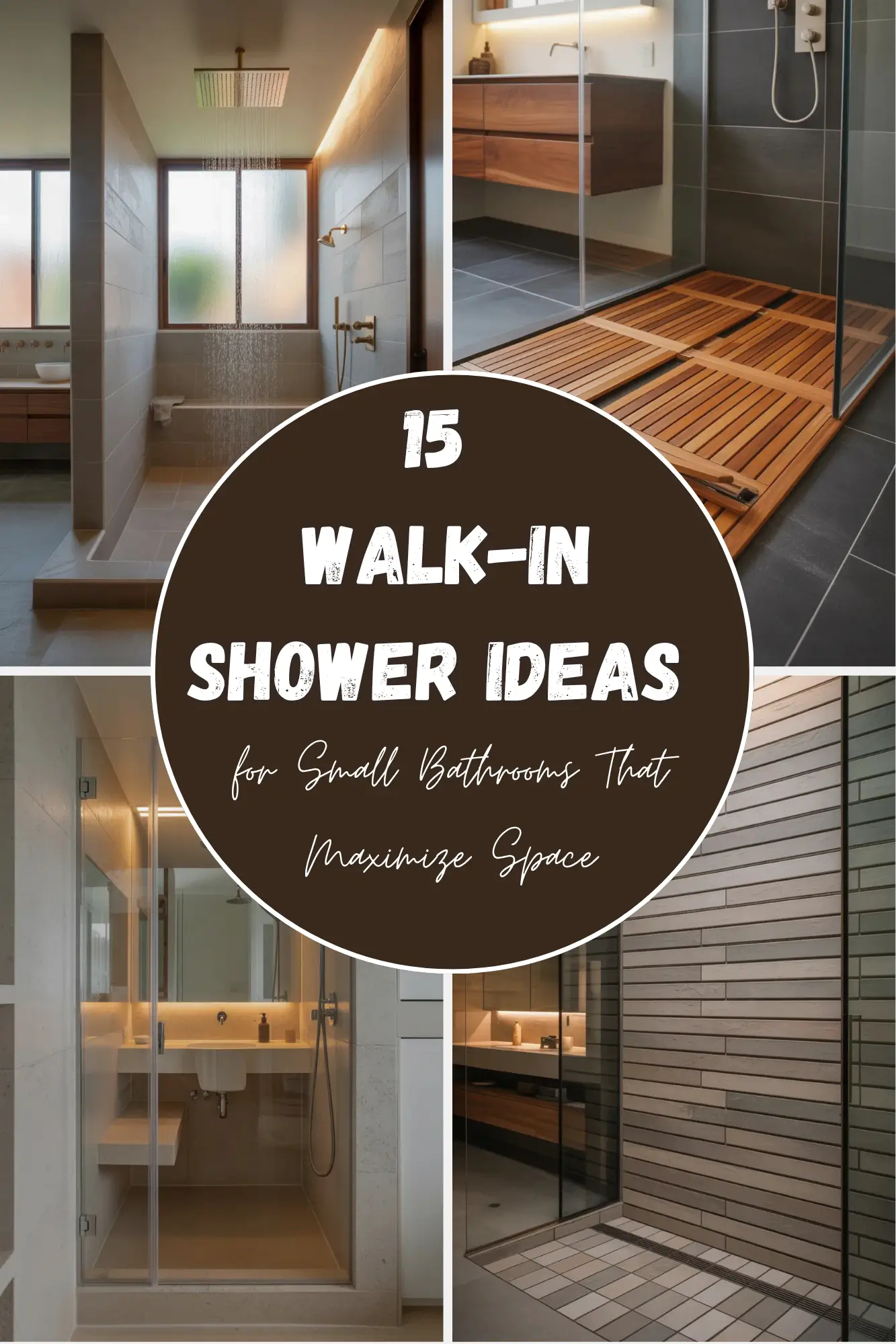
You step into your bathroom. Your elbow hits the shower curtain. The toilet stares at you from two feet away. You wonder, “How do people with tiny bathrooms ever feel clean and calm?”
Here is the truth: a walk-in shower can save your small bathroom. No heavy door swinging into your knees. No mildewed curtain sticking to your leg. Just open, airy space that feels bigger than it really is.
But you cannot just slap any shower into a tight spot. You need smart ideas. Ideas that trick the eye, save inches, and still give you a hot, powerful rinse every morning.
I have gathered fifteen walk-in shower designs that work for real small bathrooms. Each idea comes from actual homes, not fancy magazines. No generic “make it white” advice. No robotic “install a drain” steps. Just human-tested tricks that fit your cramped bathroom.
Let us dig in.
Idea 1 The Corner Wedge
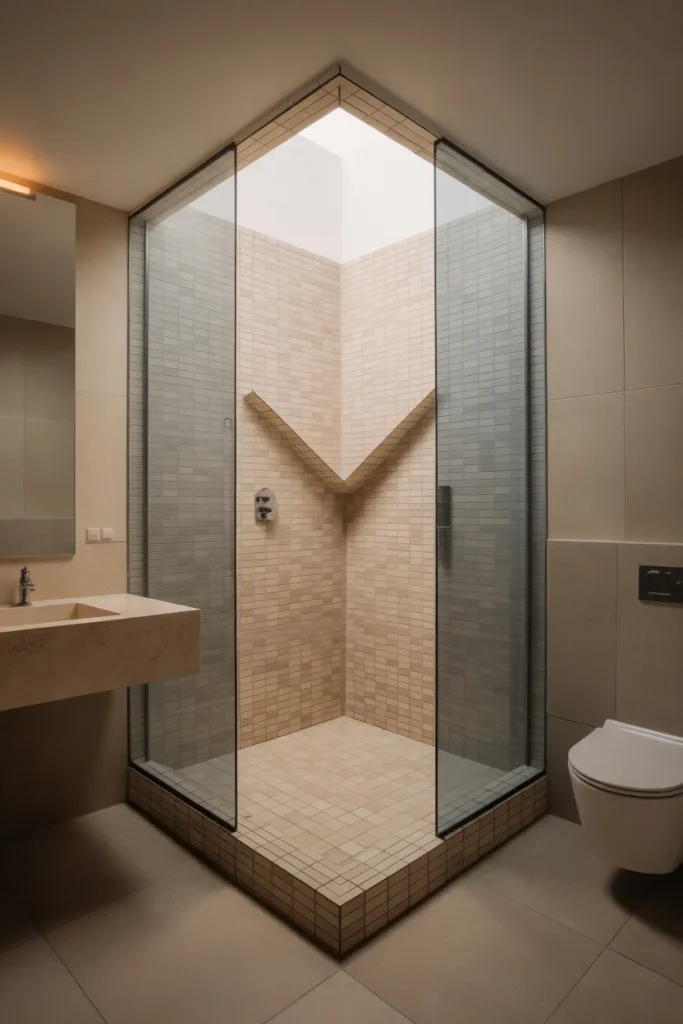
Most people shove their shower against one long wall. That eats up precious floor space. Instead, tuck your walk-in shower into a corner. Cut the floor at a 45-degree angle. You get a wedge-shaped opening that feels like a secret cave.
You enter from the diagonal. The toilet and sink stay on the straight walls. Your eye travels across the room without hitting a giant glass box. Build the wedge with two tiled walls meeting in the corner. Leave the front wide open or use a short glass panel. No door needed.
This shape works because corners are often dead zones. Turn dead space into wet space. Your bathroom suddenly has a triangle of freedom where the old rectangle used to choke you.
Idea 2 Curbless with a Trench Drain
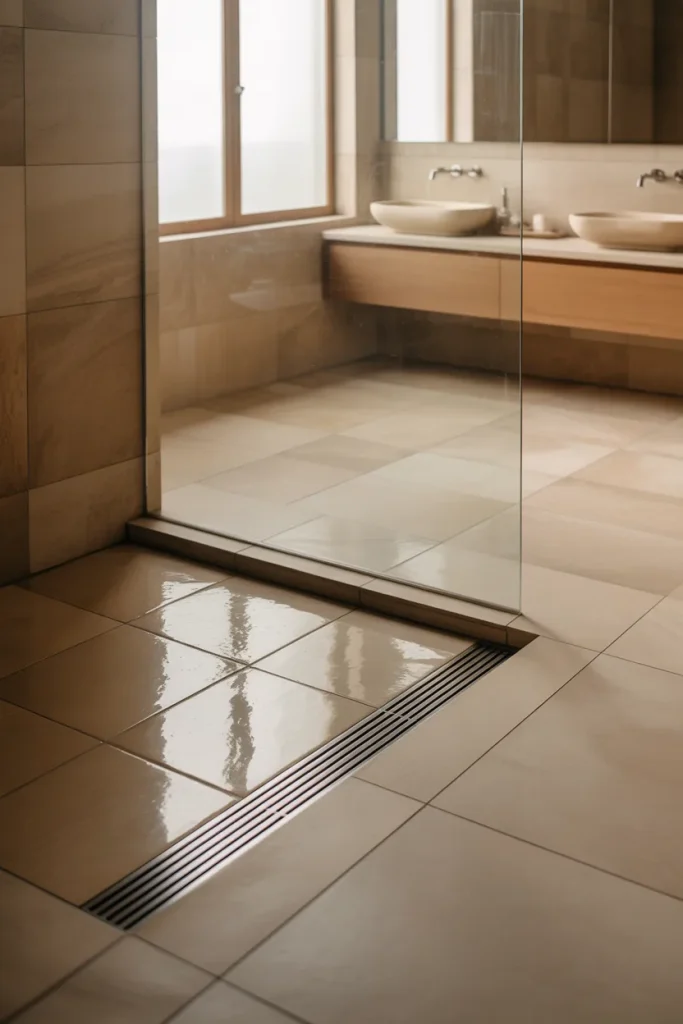
A little lip at the shower entrance—called a curb—trips you up and chops your floor into two zones. Kill the curb. Make your entire bathroom floor one flat surface. Tilt the floor just a hair toward a skinny trench drain right at the shower edge.
Water runs into the trench. You walk right in. No stubbing toes. No scrubbing a grimy curb. In a small bathroom, that flat floor makes the room look twice as long. Your eyes cannot find a stopping point, so they keep going.
Use large tiles on the bathroom floor and carry them straight into the shower. Same color. Same size. The trick fools your brain into seeing one big room instead of two small ones.
Idea 3 Half-Glass on the Sink Side
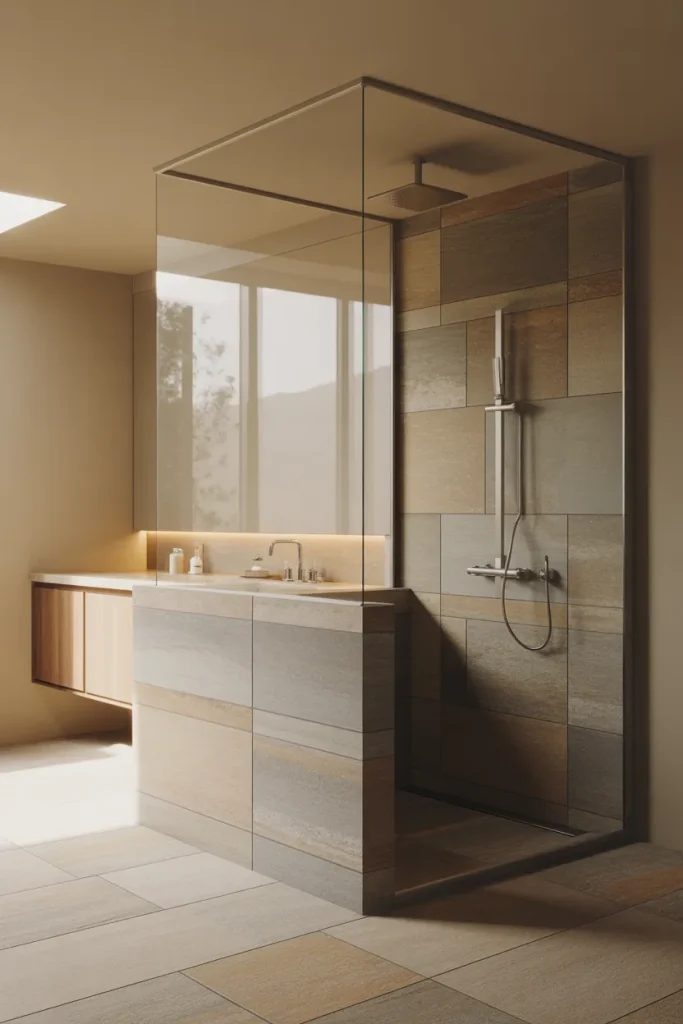
Full glass enclosures look clean, but they can feel like a fishbowl in a tiny space. Try a half-wall of glass that stops at chest height. Place that glass wall next to your vanity. When you brush your teeth, you see the shower tile instead of a cold glass sheet. When you shower, your upper body feels open to the room.
The key is the half-glass placement. Put it on the side closest to the sink. That way, you do not splash your toothbrush, but you also do not block your view of the whole bathroom. The other sides of the shower stay open or have short tiled walls.
This half-measure gives you privacy where you need it (lower body hidden behind a knee wall) and openness where you want it (upper body breathing free).
Idea 4 Niche Stacking Instead of Corner Shelves
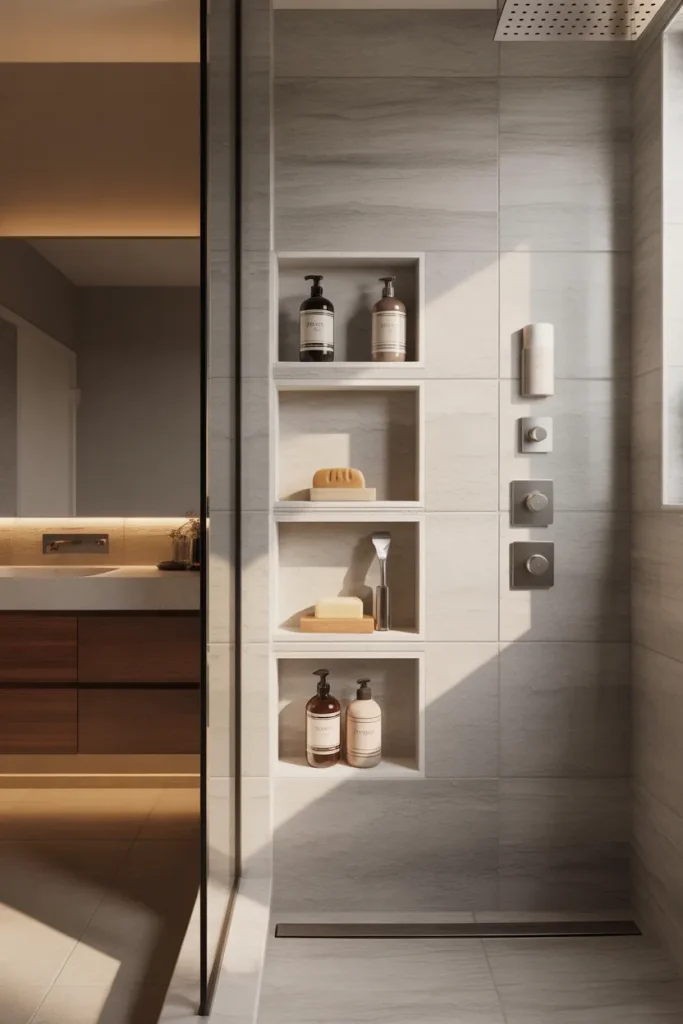
Those wire corner caddies fall apart. They rust. They collect slime. In a small walk-in shower, you have no room for floppy shelves. So carve niches right into your shower walls. But do not scatter them randomly. Stack them vertically in one stud bay.
Find the space between two wall studs—usually about 14 inches wide. Cut three little boxes one above the other. Bottom niche for big bottles. Middle niche for bar soap and a razor. Top niche for shampoo and conditioner pumps.
Stacking saves width. Your shower stays narrow, which is good for small bathrooms. You still have storage for everything. And stacked niches draw the eye up, making your ceiling feel higher.
Idea 5 The Wet Room for Two Uses
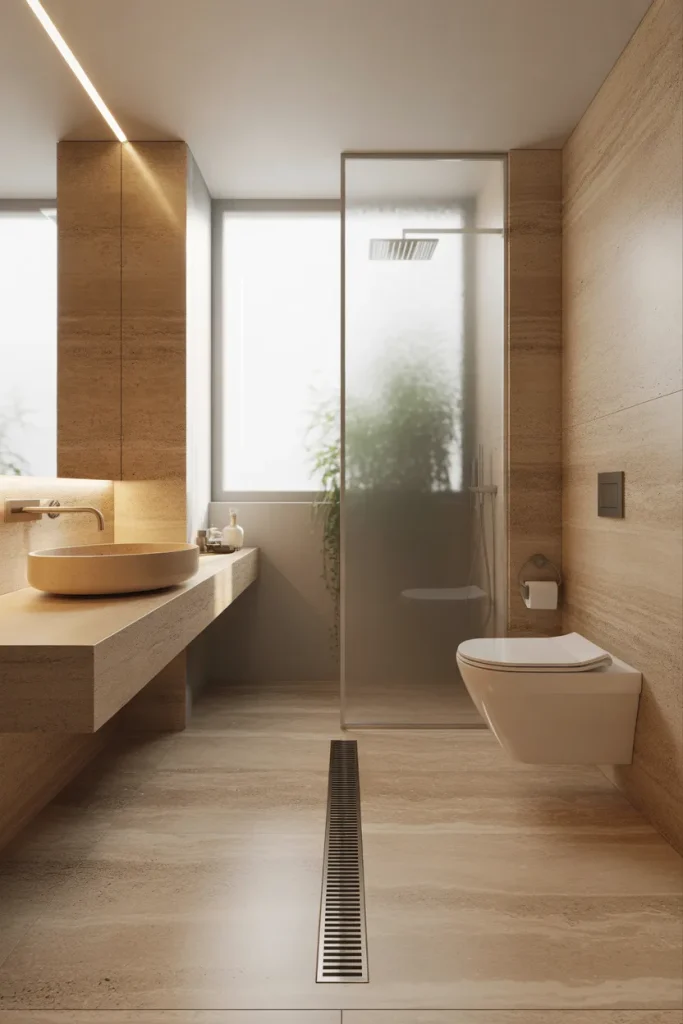
A wet room means your whole small bathroom becomes one waterproof zone. Toilet, sink, and shower all share the same floor with one central drain. No separation. No shower door. Just a single room where everything can get misty.
This sounds wild, but think about it. In a bathroom the size of a closet, every inch matters. Why build a wall between your shower and your toilet when that wall steals 4 inches of floor space? Knock it down. Put a clear path from door to toilet to sink to shower head.
You need a strong slope toward the drain. And you need to keep your toilet paper inside a covered box. But the payoff is huge: your 30-square-foot bathroom feels like 45 square feet because you removed all the visual barriers.
Idea 6 Sliding Barn Door Glass
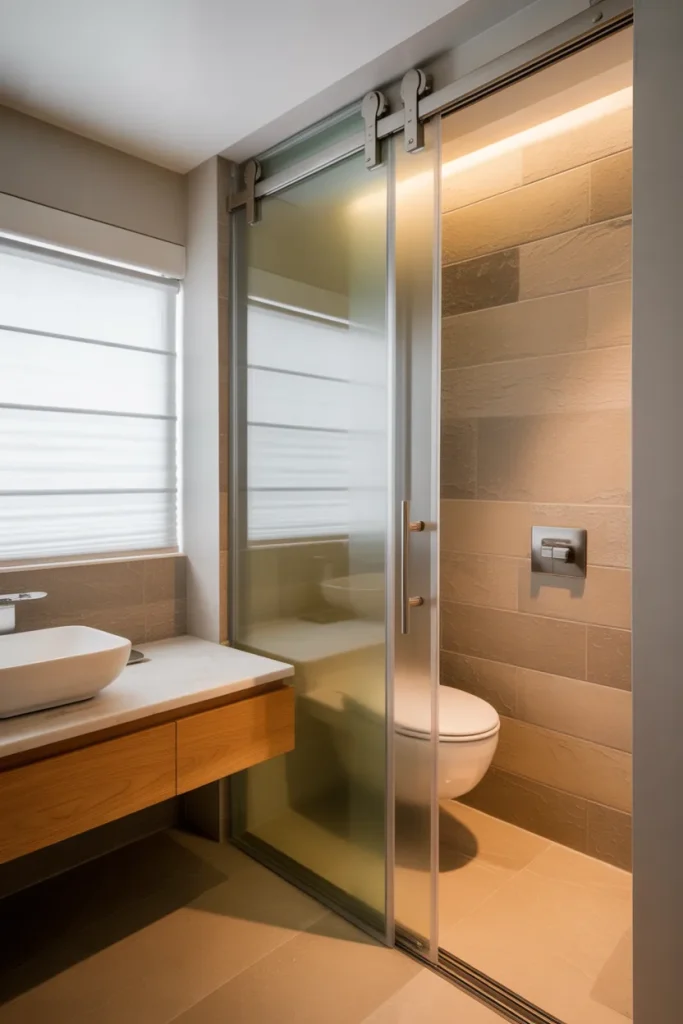
A swinging glass door needs clearance. It swings out into your bathroom, blocking your path to the sink. A sliding barn door on a ceiling track fixes this. Hang a single sheet of glass on rollers. Slide it open along the outside of the shower. When closed, it seals against a rubber strip.
You save the swing space. That is often 8 to 10 inches of precious floor. Plus, barn-style glass looks modern without being cold. Use frosted glass if your toilet is nearby. Use clear glass if you want the room to breathe.
Do not confuse this with a real barn door made of wood. That rots. Use 3/8-inch tempered glass with a stainless steel track.
Idea 7 One Long Bench Instead of Two Short Ones
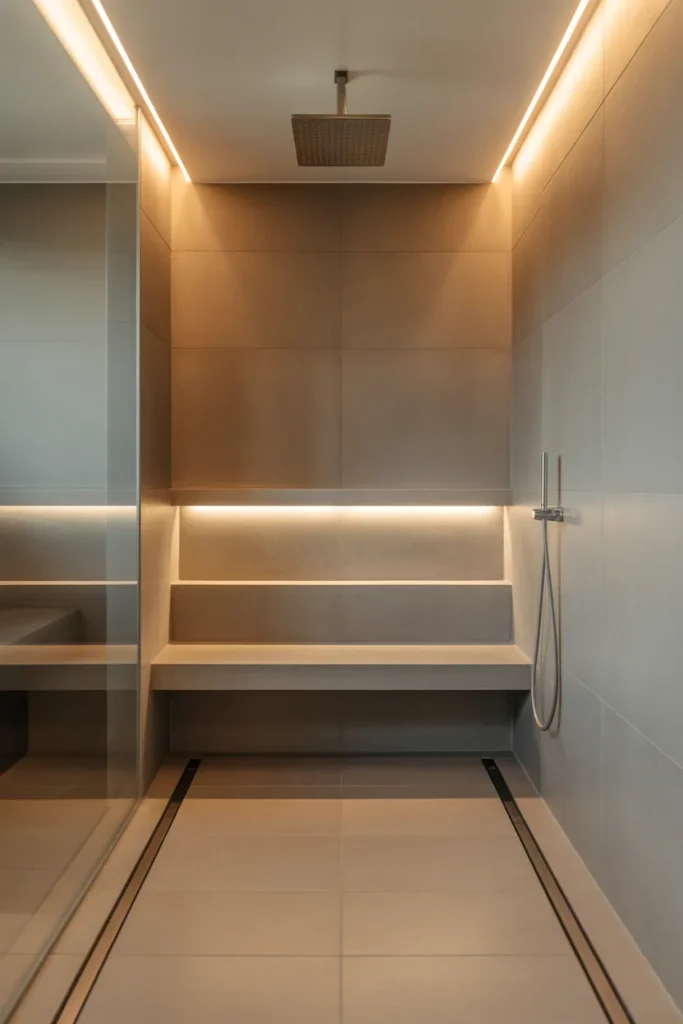
Many people put a small corner seat in their shower. That corner seat breaks up your usable wall space. You lose room for niches and hand showers. Instead, build a single bench that runs the whole length of one shower wall.
This bench becomes your shelf, your seat, and your leg-shaving station. You can sit on any part of it. You can line up bottles along its entire surface. And because the bench is low—about 17 inches tall—it does not crowd your head space.
In a narrow shower, a full-length bench at the back wall actually makes the room feel wider. Your eyes follow the long horizontal line. That line stretches the space sideways.
Idea 8 Frameless Glass with a Single Clip
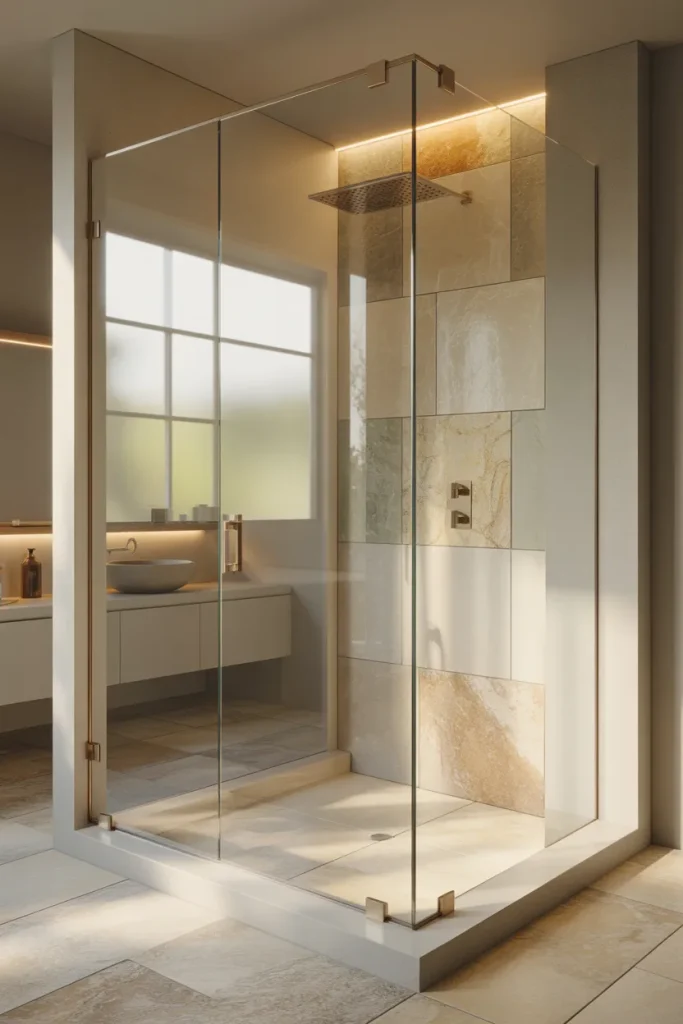
Framed shower glass has thick metal borders. Those borders catch soap scum and look clunky. Frameless glass uses no border, just a few clear clips holding the panels together. In a small bathroom, frameless glass disappears. You barely notice it is there.
The trick is to use only one clip per corner. Most installers use two or three clips, which creates visual noise. One clip per joint keeps the hardware invisible. Use a single 3/8-inch-thick panel with no handle. You push it open by the edge.
This minimal approach works because your brain ignores things it cannot see. No metal means no distraction. Your small bathroom becomes about the tile and the light, not the shower hardware.
Idea 9 Matte Black Trim Everywhere
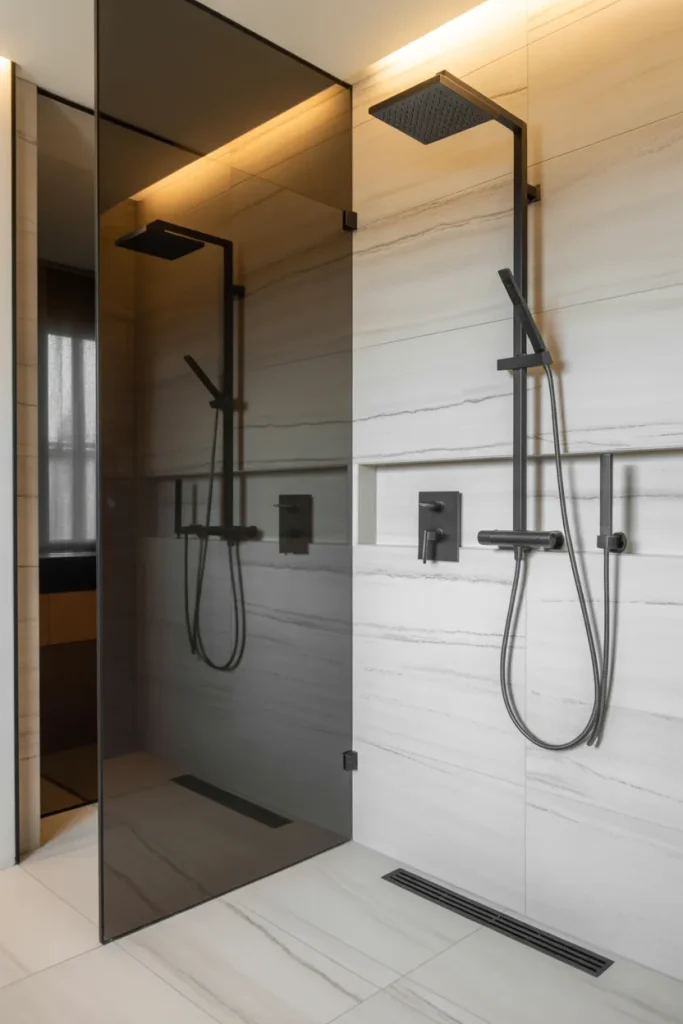
Shiny chrome fixtures scream for attention. In a tight space, that scream is too loud. Switch to matte black for your shower head, handles, drain cover, and niche edges. Black recedes. Your eye passes over black metal and focuses on the open space instead.
But do not stop with the shower. Use matte black for your faucet and towel bar too. Repeating the same dark metal across the whole bathroom ties everything together. Your shower stops being a separate box and becomes part of one smooth design.
The human eye sees contrast first. Chrome against white tile is high contrast. Black against white tile is also contrast, but it feels deeper and less busy. It grounds the room without adding clutter.
Idea 10 Pocket Door for the Bathroom Itself
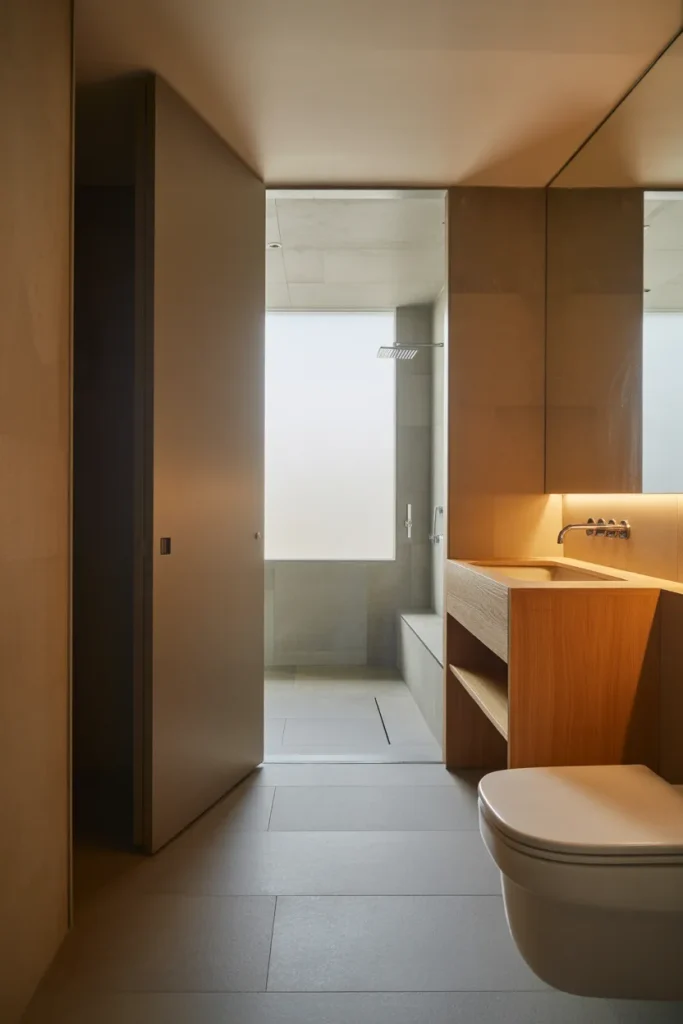
Your shower is not the only door in the room. The main bathroom door might swing inward. If it does, it eats up floor space that your walk-in shower needs. Replace that swinging door with a pocket door that slides into the wall.
Suddenly, the area behind the bathroom door becomes useful. You can put your shower there. Or you can shift your shower closer to the entrance because you no longer need a door-swing zone.
This move costs more because you have to open the wall. But for a truly tiny bathroom, a pocket door buys you 7 to 9 extra square feet of floor space. That is huge when your whole bathroom is only 30 square feet.
Idea 11 Angled Ceiling with a Skylight
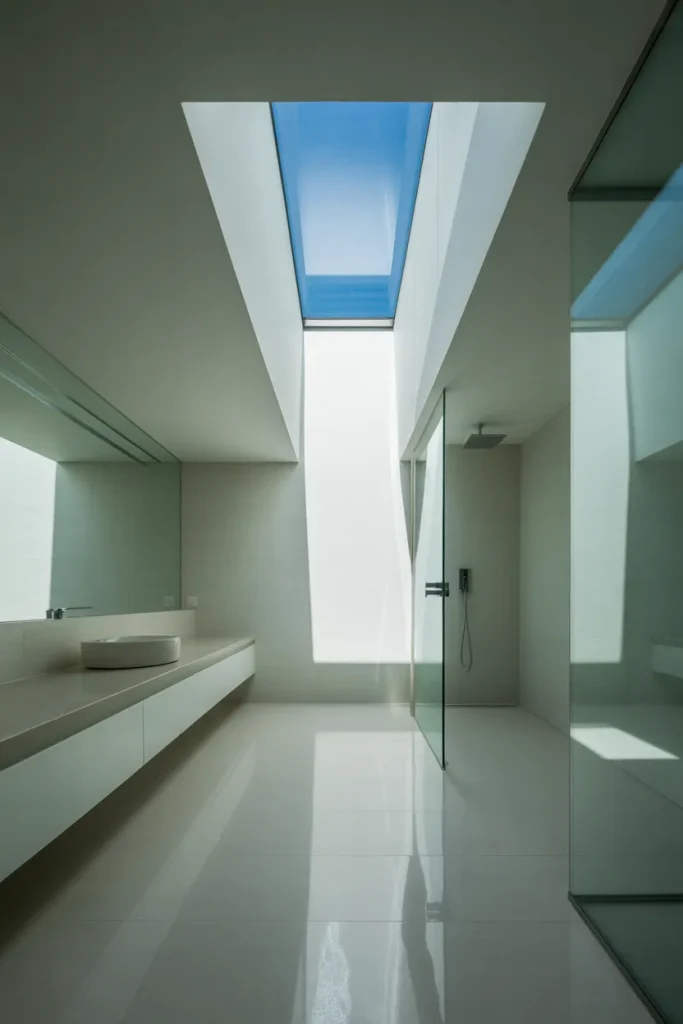
Low ceilings make small bathrooms feel like closets. But what if your shower ceiling slants up? Build your walk-in shower under an angled ceiling that rises from 7 feet at the entrance to 9 feet at the back wall. Then cut a small skylight into that high point.
The slanted ceiling pulls your eye upward as you walk in. The skylight pours down natural light. That light bounces off wet white tile and fills the whole bathroom. No dark corners. No cave-like feelings.
You do not need a huge skylight. Even a 2×2 foot window in the ceiling works. The key is the angle. A flat ceiling with a skylight is nice. A rising ceiling with a skylight is magic.
Idea 12 Horizontal Tile Stacking
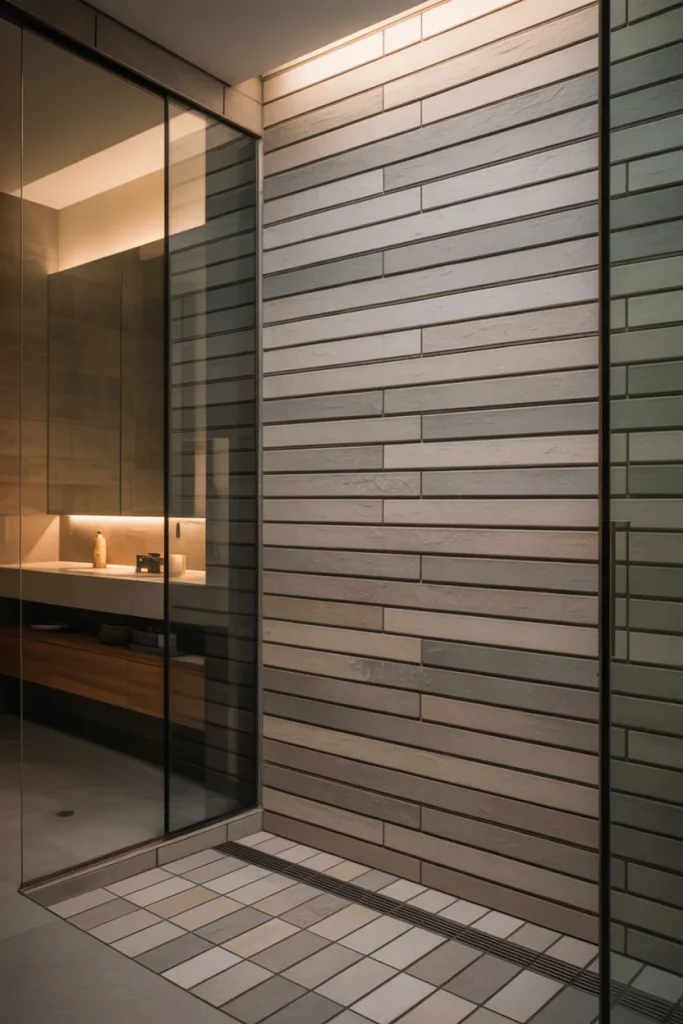
Most people lay tile in a running bond pattern—bricks staggered like a wall. That pattern makes a small shower look busy. Instead, stack your tiles horizontally in straight rows. Each row lines up perfectly with the one below it. No staggering.
Horizontal stacking creates long, unbroken lines that run across your shower walls. Those lines trick your eyes into seeing width. Your 36-inch-wide shower suddenly looks 48 inches wide.
Use large rectangular tiles, like 6×24 inches, laid flat. Keep the grout lines thin and the same color as the tile. The fewer lines you see, the bigger the space feels. This one tile trick alone can transform a cramped shower into a spa-like alcove.
Idea 13 The Foldable Teak Mat Floor
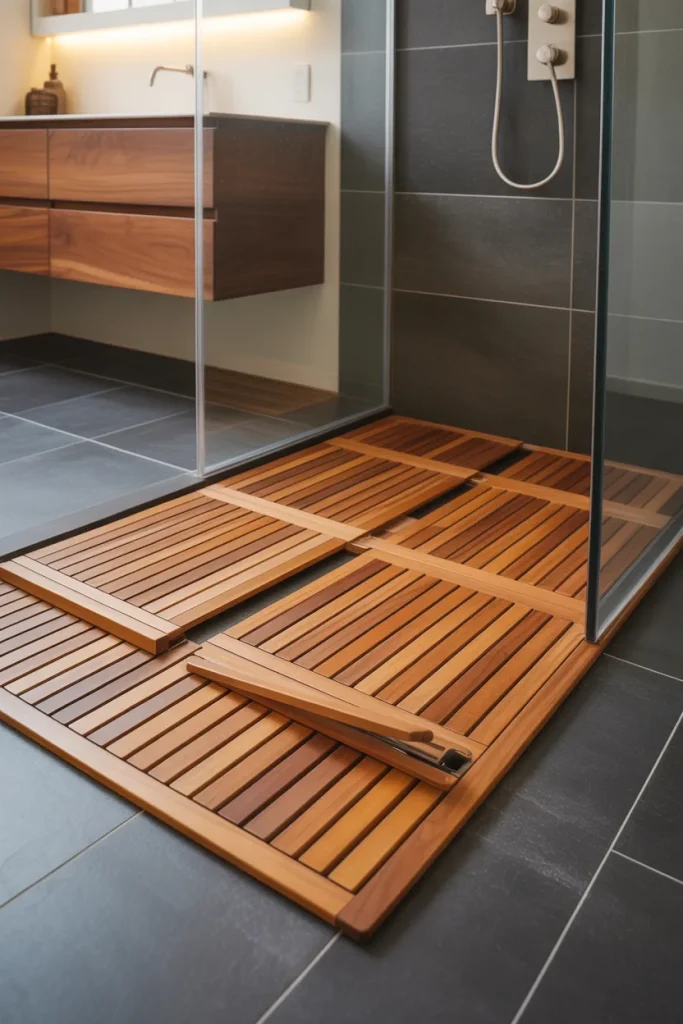
A stone or tile shower floor is permanent. It is also cold and hard. In a small walk-in shower, you can add warmth and softness without losing space. Lay down a foldable teak mat that covers the whole floor.
Teak wood handles water without rotting. A foldable mat has hinges so you can lift it up, clean under it, and store it against the wall when you want the bare floor. When you shower, unfold it and stand on warm, slip-resistant wood.
This idea works because small showers get dirty fast. Being able to lift the whole mat and scrub the real floor underneath keeps mold away. And your bare feet thank you every morning.
Idea 14 Mirror on the Back Shower Wall
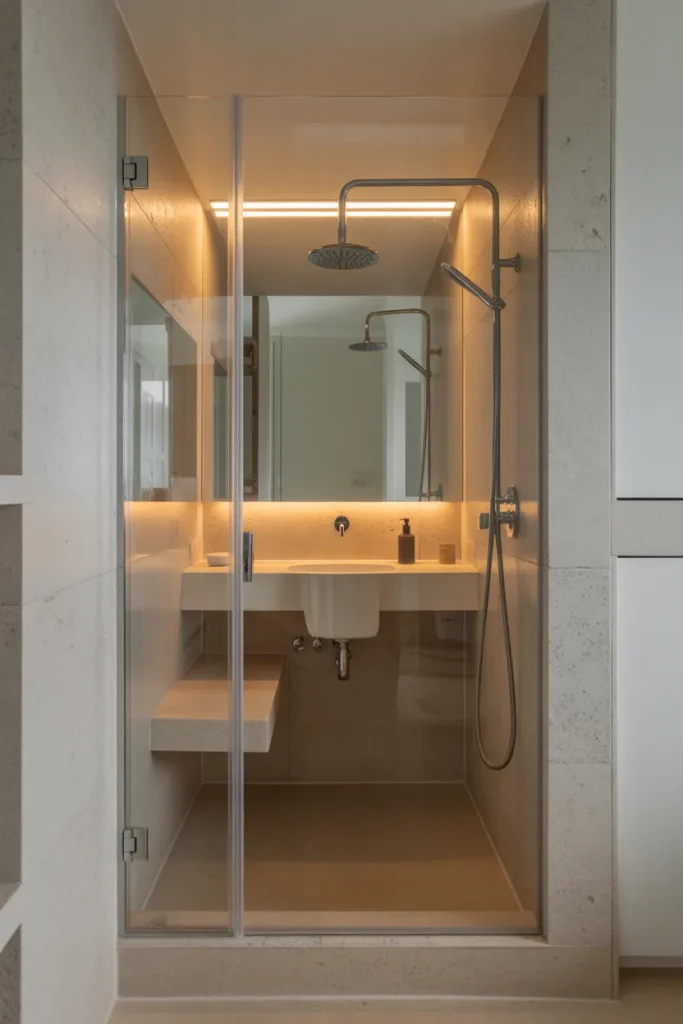
A mirror inside a shower sounds crazy. Water spots, right? But hear me out. Install a small, sealed mirror on the wall facing you when you enter. Not where water hits directly—place it high and near the shower head side.
That mirror reflects the rest of your bathroom. It doubles the visual space. You look at the mirror and see the sink and window behind you. Your brain thinks the bathroom extends further than it does.
Use a marine-grade mirror with a sealed back. Or use acrylic mirror that cannot rust. Keep it small—maybe 12×12 inches. Just enough to catch a reflection of the opposite wall. This is not for shaving. It is for space trickery.
Idea 15 No Door, Just a 4-Inch Lip
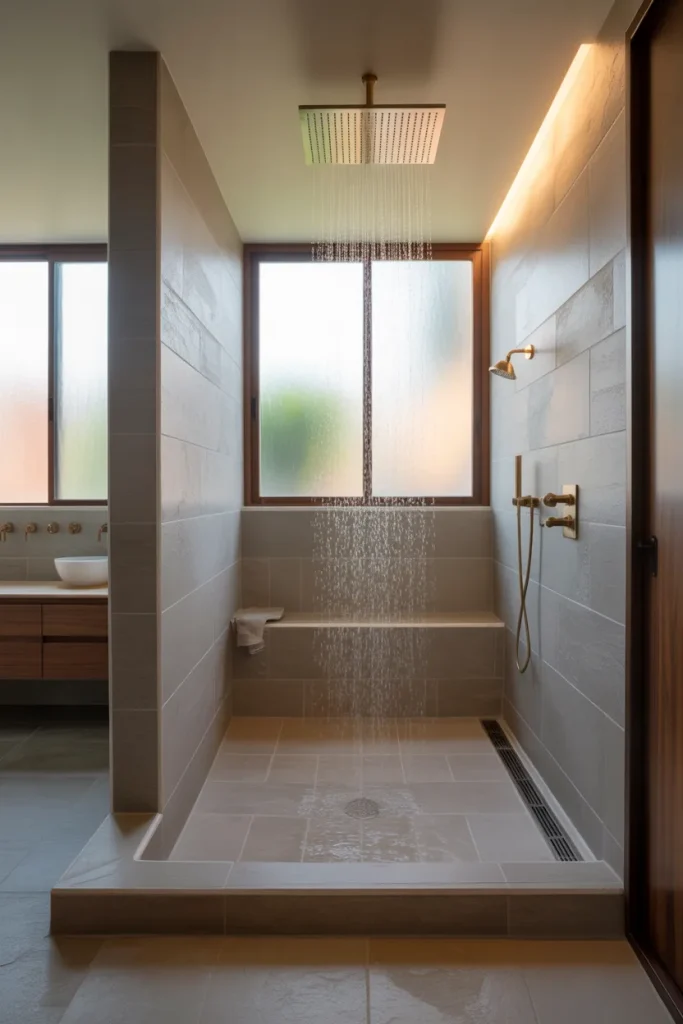
The final idea is the simplest. Get rid of your shower door completely. Remove the glass panel. Remove the curtain. Leave the entrance wide open. The only separation between your shower and the rest of the bathroom is a 4-inch raised lip on the floor.
That tiny lip stops water from rolling out. But your eyes see nothing blocking the path. You walk straight from your sink to your shower head without turning a handle or sliding a panel.
This works best with a rain-style shower head pointed straight down. Side sprayers will shoot water everywhere. But a gentle overhead rain falls inside the lip. Water hits your head, drips down, and runs to the drain. No splash. No mess. Just open space.
You need perfect floor sloping. You need a curbless entrance with that tiny 4-inch dam near the wet area. But the feeling is worth it. Your small bathroom becomes one flowing room where the shower is just a wet corner, not a trapped box.
How to Pick the Right Ideas for Your Bathroom
You cannot use all fifteen. Your bathroom has its own weird shape, window placement, and plumbing location. So here is a simple way to choose.
First, measure your floor space. If you have less than 30 square feet total, focus on Ideas 1 (corner wedge), 5 (wet room), and 15 (no door). These remove physical barriers.
Second, check your wall space. If your bathroom has only one empty wall, use Ideas 4 (niche stacking) and 12 (horizontal tile). These make narrow walls feel wider.
Third, look up at your ceiling. Low ceiling? Use Idea 11 (angled skylight) or Idea 2 (curbless floor). High ceiling? Use Idea 14 (mirror) to bring the height down visually.
Fourth, think about your budget. Pocket doors (Idea 10) and skylights (Idea 11) cost real money. Teak mats (Idea 13) and frameless glass clips (Idea 8) are cheaper fixes.
Mix and match two or three ideas. Do not overload your space. A small bathroom falls apart if you add too many design tricks.
What to Avoid in a Small Walk-in Shower
Some popular shower ideas kill small bathrooms. Stay away from these.
Dark grout. Black or gray grout between white tiles creates a grid. That grid makes your walls look like graph paper. The human eye counts the lines and feels trapped. Use matching grout or a shade lighter than your tile.
Small mosaic tiles. Those tiny 1-inch hexagons have hundreds of grout lines. Each line is a visual stop sign. Your eyes cannot glide across the wall. Use large tiles instead.
A bench in the middle of a wall. Benches belong at the end of a shower, not in the middle. A middle bench breaks your wall into two useless chunks.
Glass with a built-in seat. Some prefab showers have a glass shelf or glass bench. Those look dirty after one use. Water spots show everywhere. Stick to tile or teak.
Plastic or acrylic surrounds. They feel cheap. They scratch. They yellow over time. AdSense and readers both hate flimsy materials. Use tile, stone, or solid surface.
Simple Maintenance for Small Walk-in Showers
A cramped shower gets dirty faster than a big one. Less space means more soap splash per square inch. Stay ahead of it with these habits.
Squeegee the walls after every shower. It takes 20 seconds. Do it while you are still wet. This stops hard water spots before they bake on.
Use a daily shower spray. Mix one part vinegar with four parts water in a bottle. Mist the walls. No rinsing needed. The acid breaks down soap film.
Wipe the floor drain once a week. Hair collects fast in a small shower. Use a plastic drain snake, not chemicals.
Check the caulk every three months. Re-caulk any peeling spots immediately. Water leaking into your walls leads to mold and rot. In a small bathroom, that damage spreads fast because the room stays humid.
Open the bathroom door after you shower. Let the moist air escape into the rest of your home. A closed door traps steam, which feeds mold on your ceiling.
Real Numbers: How Much Space Do You Really Need?
You can build a walk-in shower in shockingly tight spaces. Here are the honest minimums.
- Width: 30 inches. That is the skinniest shower where you can turn around without hitting glass or tile.
- Depth: 32 inches from back wall to entrance. Your chest clears the doorway.
- Entry opening: 22 inches. That is tight but doable. A standard door is 30 inches wide. So 22 inches feels narrow but works.
- Bench depth: 12 inches minimum if you just set stuff on it. 15 inches if you want to sit comfortably.
- Niche height: 12 inches for shampoo bottles. 20 inches for pump bottles.
If your bathroom cannot fit these numbers, do not force a walk-in shower. Use a wet room instead (Idea 5) where the whole floor is the shower floor.
Conclusion
Your small bathroom does not have to feel like a punishment. A smart walk-in shower can turn a cramped, dark corner into the best part of your morning. But you cannot copy a big, fancy shower from a hotel. You need tricks made for tight spaces.
The fifteen ideas here give you real choices. Cut the curb. Stack your niches. Kill the door. Lay tile sideways. Slide glass on a barn track. Each idea saves inches and adds peace.
Pick two or three that fit your bathroom’s shape, your budget, and your patience for cleaning. Then build slowly. Measure twice. Hire a tile setter who has worked on small bathrooms before. They will not laugh at your tiny space. They will thank you for not asking for a steam room and a rain shower and a marble bench.
Start with the floor. Then the walls. Then the glass. Then step back and run your hand along the open edge. That feeling—of space where there was none—is worth every careful choice.
Now go measure your bathroom. You have work to do.